
Chapters from the Life of Alice Herz-Sommer
Family and childhood
Alice Herz was born in 1903 as the younger of twins into a German-Jewish family in Prague. Her mother, Sofie, came from Jihlava, from the German-speaking family of the merchant Ignatz Schultz. Her father, Friedrich Herz, had already been engaged in business in Prague before his marriage; his company was the first in the Habsburg monarchy to produce precision scales of all kinds.
Alice and her twin sister Marianna, known as Mizzi, had three older siblings: Georg the eldest, Irma the second, and third older sibling Paul. From the beginning, Mizzi was very small and frail, and there were fears for her survival. The sisters differed not only in appearance but also in character—Mizzi was rather timid, while Alice was courageous. Their mother devoted much of her attention to Mizzi, often soothing her, whereas Alice found comfort and a sense of safety primarily in her father. As a child, Alice sought her mother’s attention by helping with household chores, such as carrying heavy buckets of water upstairs, until her grandmother Fanny eventually intervened on her behalf. The contrast between the sisters remained evident throughout their lives and shaped their personalities: Mizzi tended to be anxious and pessimistic, while Alice grew into a bold, confident, and optimistic woman.
Alice and Judaism
Mother Sofie did not talk much about her Jewish origins. She turned away from the faith at the time when she was forced to enter into a prearranged marriage with Friedrich. She tried to integrate into Prague’s German cultural life and then enable her children to achieve higher education. She wanted them to grow up to be cosmopolitan Germans with a sense of art, without the stigma of Judaism. It was the grandmother who told the girls about the Jewish people and the customs. The girls liked to stay with her and participate in the preparations for the Sabbath. Father Friedrich usually went to the synagogue once a year, on the Day of Atonement ‒ on Yom Kippur. The whole family always had great preparations for Passover. At that time, people cleaned, washed dishes and cooked. During dinner, friends and the poor were invited to the house. And in return, the father tolerated a modest Christmas celebration for the family, they even baked Christmas cakes, but the Herz family did not have a tree.
Alice and music
At their grandmother’s, as children, Alice and Mizzi were introduced to the story of Gustav Mahler, his childhood and musical talent. Alice was excited about this and she decided to be a musician as well. She practiced playing the piano every day, both in the morning before going to school and in the afternoon, and sometimes she sneaked out of bed at night for the same reason. Her first teacher was her older sister Irma. When Alice was about ten and her brother Paul was thirteen, they demonstrated what they had learned almost every day. Alice played the piano and Paul played the violin. Mom loved these moments, while Dad always distanced himself. In 1915, Irma took her sister for the first time to her teacher Václav Štěpán. He was amazed at what Alice had shown him, and surprised at how often she played at home. They agreed to have a piano lesson once a week, and for the next ten years, Štěpán was her most important teacher.
After World War I
In 1920, both Alice and Mizzi graduated from the girls’ lyceum. Mizzi continued to attend business school, Alice wanted to be a pianist. Early in September, the long-planned German Academy of Music and Fine Arts was supposed to open with a piano master class. Alice diligently prepared for the entrance exams and was admitted. During her studies at the academy, she experienced her great love affair with Rudolf Kraus, the older brother of her friend Trudy and also the son of a dentist who took care of the Herz family. Rudolf was also a dentist, but he was already thirty-three years old and was looking for a life partner. In the end, he preferred an older woman to Alice.
Alice was devastated by unhappy love and music helped her get over the breakup. In 1923, she was offered to make her debut at the Czech Philharmonic a year later with Chopin’ s Piano Concerto No. 1 in E minor. However, only a few days before Alice’s concert debut, Moritz Rosenthal, considered the greatest virtuoso at the time, performed the same piece of music at the Deutsche Philharmonic. Despite her initial uncertainty caused by this fact, however, Alice stood up to her debut. She was rewarded not only with strong applause, but also with an article in the daily Prager Tagblatt:
“Many an aspiring talent could be confused by the fresh memory of Rosenthal’s interpretation a few days ago. Alice Herz did not let her individual conception be spoiled and it must be admitted that she surpassed her famous colleague with the warmth of her feelings and the warmth of expression. The originality of her technique and her ability to connect with the orchestra while maintaining her unique artistic temperament did not go unnoticed. This young artist, who has already garnered interest on multiple occasions, is predicted to have a bright future ahead. “[2]
At the end of 1924, one of Alice’s closest friends, Daisy Klemperer, died suddenly. Alice was severely affected by this, and as a result of the psychological shock, her immune system apparently collapsed.
Leopold
Leopold Sommer was an acquaintance of Trudy Kraus, Alice’s friend. She used to visit the sick Alice and once showed her a letter she had just received from Leopold with his reaction to the death of his friend Daisy. Leopold’s thoughts completely enchanted her. She imagined him as an exceptional, wise person. She asked Truda to introduce them to each other.
They met for the first time in the summer of 1925 and Alice was immediately captivated by Leopold. Truda organized a concert at which Alice also played, and her playing undoubtedly enchanted Leopold as well. Leopold had a business education, worked for a British import and export company in Hamburg. When he had to leave for work at the end of the summer, they exchanged letters and looked forward to meeting again.
Leopold was rather reserved, modest. He was witty, had a boundless sense of humor, and Alice felt gorgeous in his company. They were married in the spring of 1931. The young couple rented a three-room apartment near the Trade Fair Palace in Prague. Alice usually practiced piano in the morning and taught in the afternoon. They sometimes spent their evenings in theaters or at concerts. In June 1937, a son, Stephan, was born to them. He was named after Alice’s piano teacher, Václav Štěpán.
Occupation
Alice knew many Jewish artists and intellectuals from Germany and Austria who had found temporary exile in Czechoslovakia in the second half of the 1930s. They brought information about what was happening in their countries after the Nazis came to power. Alice and Leopold considered emigrating in 1938, but eventually decided to stay. Little Stephan and Alice’s mother, who could not go on a long journey for health reasons, played a role in this decision. They also lacked funds to emigrate. Alice’s two sisters, their husbands and children managed to obtain permission to go to Palestine, and on the evening of March 14, 1939, both families departed.
Alice’s mother had lived in a Jewish old people’s home since the 1940s (Her husband died already in 1930.). Alice came to visit her regularly, but she always found her in a worse condition, weaker and more desperate. In July 1942, she pressed a letter into Alice’s hand during a visit. It was a summon to transport to the Terezín Ghetto. There was a list of items she was supposed to pack. Alice was stunned. She knew that her mother had major health problems. However, there was nothing to be done, she helped her pack and the next morning she escorted her to the Trade Fair Palace to the assembly point for transports. That was the last time Alice saw her mother, as she was deported from the Terezín Ghetto to the Treblinka extermination camp in mid-October 1942, where she perished.
For Alice, her mother’s departure to Terezín was one of the worst moments in her life. She didn’t eat, she didn’t sleep, she wasn’t able to think rationally. She didn’t even play the piano. One day, however, an inner voice advised her: Twenty-four Études will save you! Fryderyk Chopin’s Twenty-four Études were masterpieces, and it was almost impossible to be able to play them all at once. Alice took up this challenge and the Études helped her return to life. At that time, Leopold worked in the organizational department of the Jewish community, and the couple knew that when his work was over, they and little Stephan would go to Terezín on one of the last transports from Prague.
Transport to the Terezín Ghetto
They were summoned for the transport in early July 1943. Stephan, then six years old, was involved in the preparations. On request, a shoulder bag was sewn for him, he helped his mother sew numbers on backpacks and name tags on blankets. On the last night before the transport, Alice had a traumatic experience when their neighbors burst into their apartment early in the morning and took everything that was not attached in some way. They even argued about the best pieces of equipment (paintings, carpets, etc.).
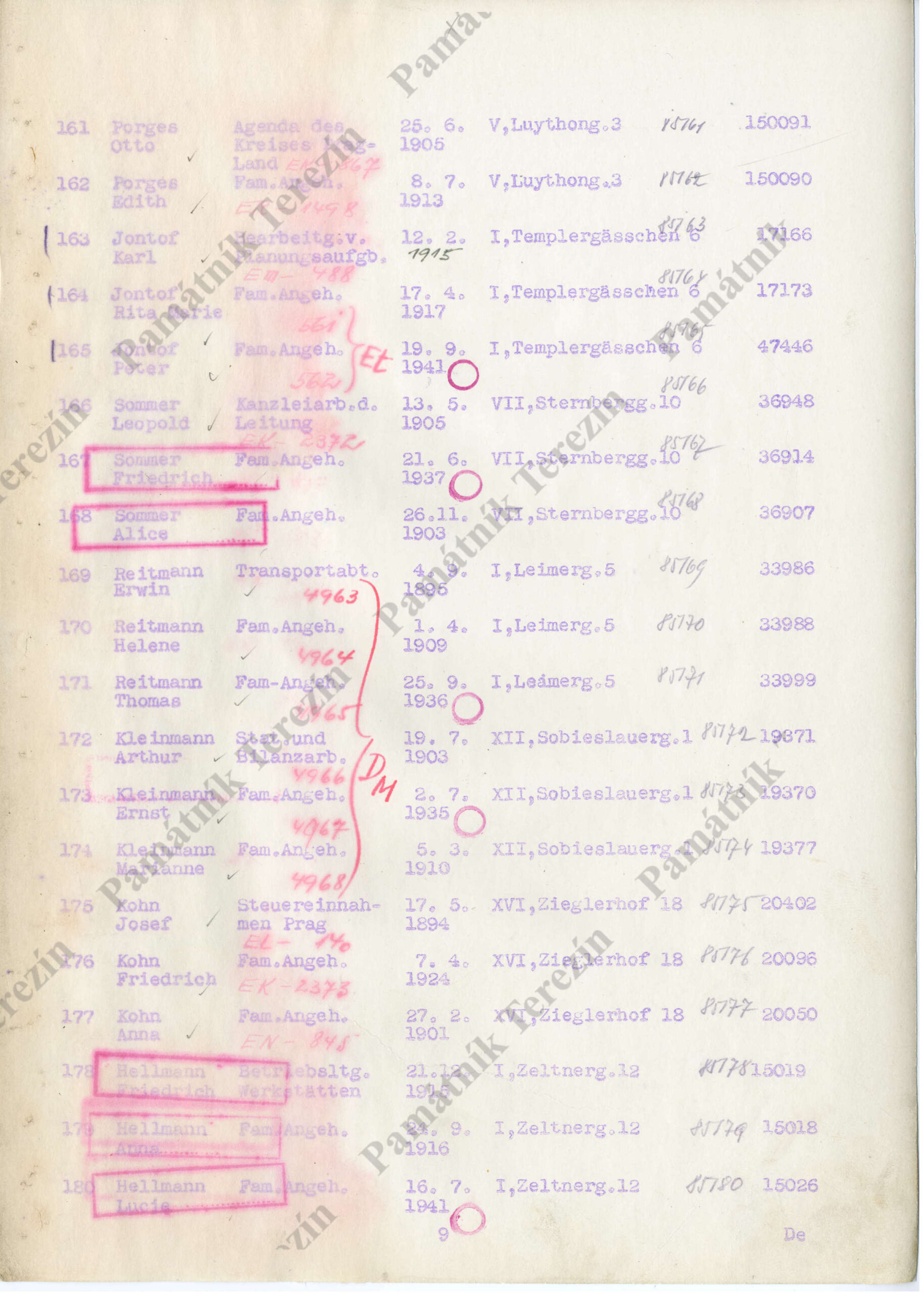
Leopold, Alice and Stephan went to the assembly point early in the morning of July 5, 1943. Leopold had the number De 166, Stephan De 167 and Alice De 168.
In the Ghetto
After arriving in the Terezín Ghetto, the family had to be separated according to the local rules. While Leopold went to the men’s quarters, Alice stayed with little Stephan and they got to the attic of one of the barracks buildings.
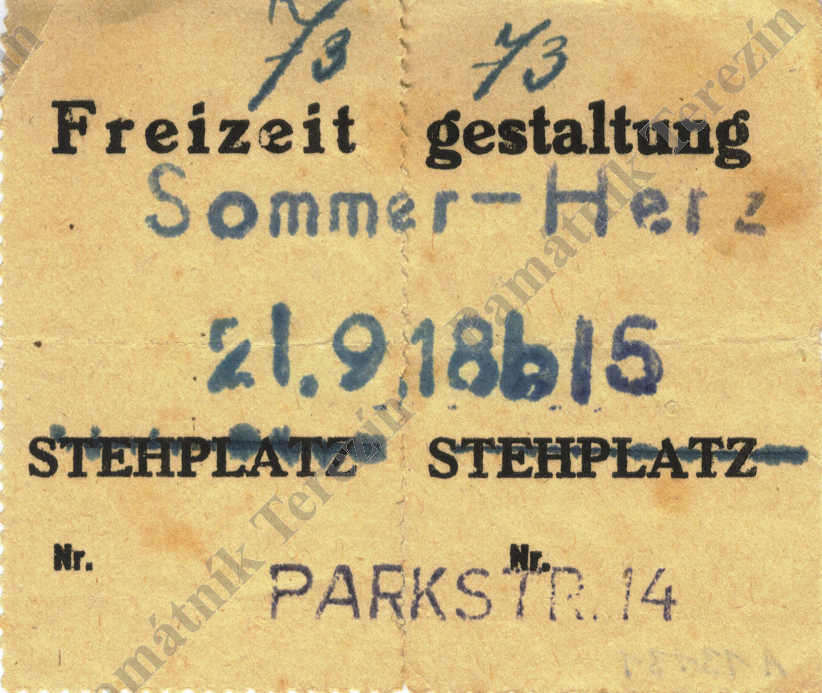
Information quickly spread around Terezín that the renowned and respected Prague pianist Alice Herzová-Sommerová had arrived. Soon she was contacted by an employee from the department for organizing leisure time of the Terezín Jewish administration, who said that she could have her first concert in a few days. Alice therefore worked in the aforementioned department and was thus exempt from physical labor.
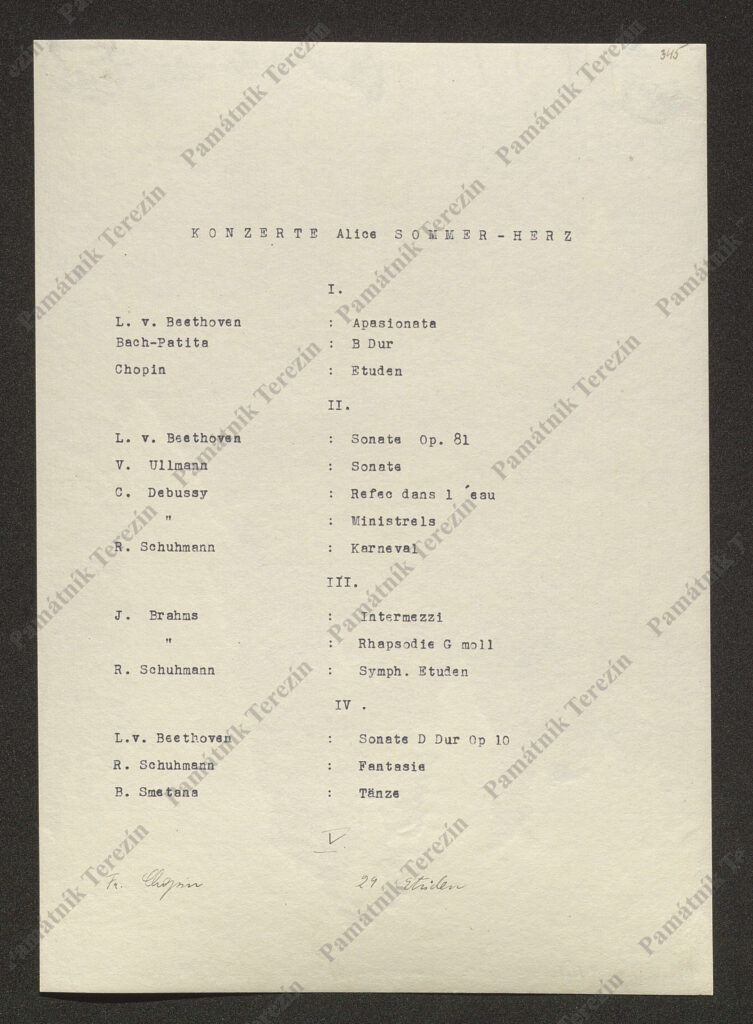
Every morning she practiced playing the piano in a small room on the ground floor of the Magdeburg Barracks. As part of her first concert in the Ghetto, she decided to play Ludwig van Beethoven’s Appassionata, Johann Sebastian Bach’s Score in B flat major, and a selection of Chopin’s études. On the program of her fifth concert, she decided to include the Twenty-four Chopin Études that she had been honing for a full twelve months.
Alice’s son Stephan, who showed his musical talent from an early age, also soon became involved in the local cultural life. He got the role of the Sparrow in the upcoming performance of the children’s opera Brundibár.
In August 1943, Alice and Stephan moved to one of the block houses on Jezerní Street. In Terezín, Alice had only one thing in mind: to take care of her child and protect him from suffering. Their stay in the Ghetto strengthened their relationship. The two of them lived together all the time, Stephan slept with Alice in her bed at night. However, she unfortunately did not manage to spare him all the pitfalls and ugliness of the Ghetto.
Autumn transports 1944
At the end of September 1944, Leopold Sommer was assigned to a transport to the East. In a matter of several days in a row, one transport after another departed from Terezín. Nevertheless, according to the commandant’s office, cultural life should not have subsided, although a number of artists had to leave forcibly. Alice continued to give concerts. After one concert, an SS officer stopped her on the street and asked if she was Alice Herz-Sommer. He told her how much he liked her play and that it made him forget about the madness of war and the conditions in the Ghetto. From a distance, she heard him say that neither she nor her son would be on the transport list.
After the departure of the autumn transports, Alice and Stephan were left alone in the room that had previously been shared by twelve people. Alice had to begin working immediately in the washhouse, but she needed someone to look after her son while she was at work. She eventually found an older woman to help, although Stephan was completely stunned by this arrangement. Later, Alice managed to arrange for her friend’s mother to care for Stephan during the day.
In February 1945, Alice’s brother Paul arrived in the Ghetto on a transport for people from mixed marriages. Little Stephan was excited to meet his uncle. At the end of April 1945, however, emaciated prisoners from evacuation transports began to appear in Terezín, and Stephan realized that they were coming from the same places his father had been taken to. He urged his mother to go and help them. There was no doubt that he was waiting for his dad.
Shortly before the liberation of the Ghetto, Stephan fell ill with a rare form of measles. Due to quarantine and other circumstances, Alice and the boy did not return home until mid-June 1945.
Return to Prague
After returning to Prague, Alice and her son took refuge with her sister-in-law Mary and her brother Paul, who had returned from the Ghetto earlier. At every turn, Alice was confronted with a harsh reality: none of her closest relatives, apart from Paul and her brother-in-law, had returned home; their former apartment was now occupied by another family; and she was required to apply for Czechoslovak citizenship.
Later, she managed to get an apartment, which the Jewish community helped furnish. From the furniture warehouse, they got a sofa, two chairs, a small table and a folding bed for the son. And there was also a piano for her. It was a black, medium-sized Steinway wing.
In August 1945, a seemingly unfamiliar man appeared at their door. Alice recognized him as the father of the eight children next to whom she and Stephan had lived in Terezín. He told her about his family and about her husband, Leopold, who had succumbed to typhus in the Dachau concentration camp. The man brought her his battered tin spoon as a keepsake.
Alice slowly returned to normal life, practicing the piano and teaching. Little Stephan went to school and learned to play the cello. In 1947, Alice’s sister Marianna came to visit Prague with her husband and son. After the change in the political situation in Czechoslovakia, Alice decided to go to Israel to visit her relatives. In the spring of 1949, she and Stephan left the republic and then traveled by ship to Haifa via Genoa and Brindisi. Shortly after the war, Alice decided not to talk about the Holocaust and Terezín, and after learning of Leopold’s death, she didn’t talk about him either. In Israel, she began teaching piano at the conservatory and had no shortage of students. She worked hard so that her son, who took the name Raphael here, could get a good education. She had a little trouble learning the language. She never had problems with languages, she spoke German, Czech, French and English since childhood. However, she had been fighting with Ivrit for more than ten years. In retrospect, she spoke of learning this language as “one of the greatest feats of her life”.
While studying at high school, Raphael managed to get a job at Radio Jerusalem, where he hosted a broadcast for children and youth. He read, played the cello or piano, explained musical compositions and also earned his own money. After graduation, he entered military service. Following initial training, he became the first cellist of the Israeli Army Symphony Orchestra, and since he could play other instruments, he also performed in various military bands. Thanks to this, he traveled not only around Israel, but also visited Europe.
In 1959, he went to Paris to study cello at the conservatory. At that time, the number one topic in Israel was the capture of Adolf Eichmann by the Israeli secret service (in 1960). Alice closely followed the preparations for the trial, which began in mid-April 1961. She then had the opportunity to attend it directly in the courtroom, where she was deeply shaken by the testimonies of eyewitnesses.
After graduation, Rafael achieved success in various international competitions. While studying in Paris, he met his future wife, his classmate Sylvia Ottová, who studied piano and intonation. In 1966, they were married in Paris. Rafael was admitted to the Manchester Conservatory, and the young couple moved to the UK, finally settling in London.
Alice was very painfully affected by the death of her sister Marianna in 1974. After the funeral she quit her work at the conservatory overnight and left Israel for ten months. She went to visit her son’s family in London. By that time, she already had two grandchildren, David and Ariel. Unfortunately, Raphael and Sylvia’s marriage was heading for divorce. Raphael moved in with Alice in a small apartment she rented in London, and she decided to go to Sweden so that Raphael could be alone there. After that, Alice shuttled between Israel and Europe for ten years, until at the end of the 1980s, at the instigation of her son, she decided to move to London again.
Raphael died of a heart attack in 2001, in the middle of a concert tour in Israel. His death deeply shook Alice. She suffered a mental and physical breakdown and her life was in danger. After an operation, she slowly recovered, and her mental pain gradually subsided.
Alice Herz-Sommer died in London in 2014.
Bibliography and memoirs:
Melissa MÜLLEROVÁ – Reinhard PIECHOCKI, Alice Herzová-Sommerová, Rajská zahrada uprostřed pekla (Alice Herzová-Sommerová, Paradise Garden in the Middle of Hell, Prague 2009, p. 87 (in Czech).
Milan KUNA, Hudba vzdoru a naděje (Music of Defiance and Hope), Terezín 1941-1945, Prague 2000 (in Czech).
A memoir with Alice Herz-Sommer from 19.9.1996 deposited in the USC Shoah Foundation, memory no. 20,292.
[1] Melissa MÜLLEROVÁ – Reinhard PIECHOCKI, Alice Herzová-Sommerová, Rajská zahrada uprostřed pekla (Alice Herzová-Sommerová, Paradise Garden in the Middle of Hell, Prague 2009, p. 87 (in Czech).
[2] Quotation from the documentary on Alice Herz-Sommer available at YouTube: TheLadyInNumber6. https://www.youtube.com/watch?v=8oxO3M6rAPw

