
A reflection written by the pupils of the Žulová primary school, the Czech Republic, after the meeting with Alena Lehovcová
On 20 January 2026, the attic theater in the former Magdeburg Barracks at the Terezín Memorial hosted a discussion between pupils from the Žulová and Milovice primary schools and Mrs. Alena Lehovecová, a second-generation Holocaust witness. Her story was not merely a historical lecture, but a personal testimony of courage, trauma, family bonds, and the enduring impact of the past on future generations.
Established by the Nazis in 1941, Terezín served as a Jewish Ghetto and a transit camp. Throughout its operation, more than 140,000 Jewish prisoners from across Europe passed through its gates. While tens of thousands succumbed to the lethal combination of starvation, disease, and exhaustion, many others were deported in transports to extermination camps in the East. Despite the crushing burden of overcrowding and starvation, a profound spirit of resistance emerged among the inmates. Through solidarity and hope, they strove to preserve their humanity and endure.
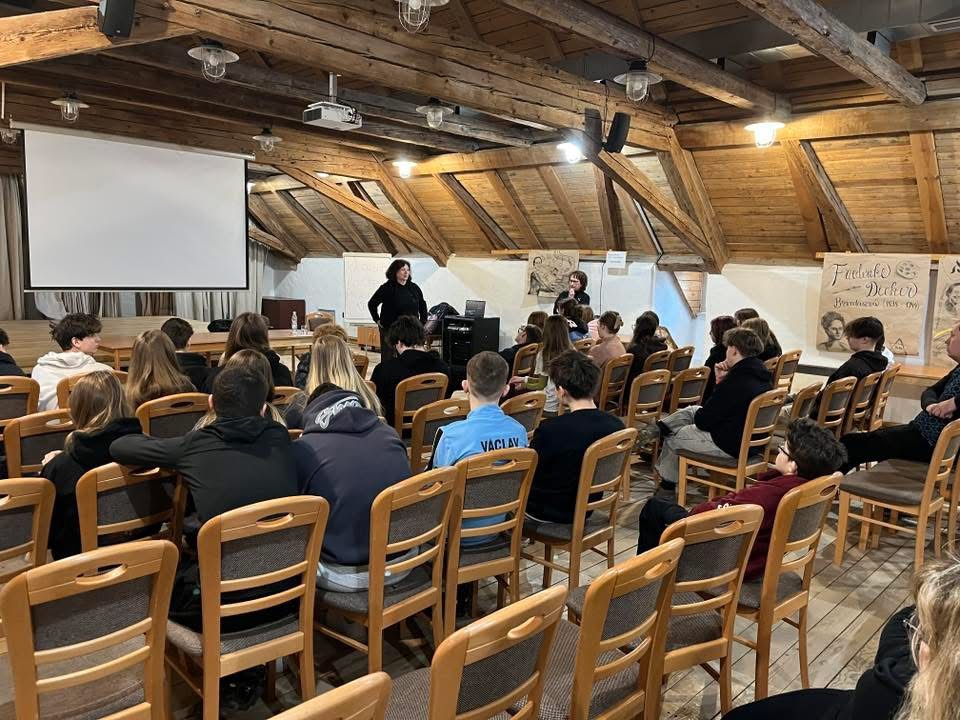
Mrs. Lehovcová recounted the story of her mother, Anna, known as Anka. She was only fourteen when she was forced to pack up a maximum of fifty kilograms of personal belongings and leave her home. Upon arrival in Terezín, their luggage was searched and their valuables confiscated. At the time, Anka also worried about what would happen to the animals her family had been forced to give up—wondering where all those canaries and dogs had gone.
In the Ghetto, she experienced hunger, fear, disease and death. Transported from Terezín further east, she survived the Auschwitz concentration camp. In the end, she went on a death march. Together with two friends, she managed to escape into a forest and survived. One of the pupils present at the discussion subsequently said: “I will never understand that she survived the death march, it is respectable.”
After returning to Prague, Anka tried to build a new life. She sought a partner quickly so as not to remain alone, but the marriage was unhappy. The war had taken away her adolescence—she had not learned to cook or acquire everyday skills. The trauma stayed with her throughout her life; for example, she was afraid of dogs. People would ask about the number tattooed on her arm, unaware of how painful such questions were. Nevertheless, according to her daughter, she was a strong and courageous woman. Even in inhumane conditions, she retained the ability to care for others, later raising her children with love and devoting herself to her grandchildren.
Mrs. Lehovcová also spoke openly about how the trauma of war can be passed on to the next generation. Her mother’s fear of dogs, for instance, was transferred to her children. As one pupil reflected: “I was captivated by the whole story and the narration passed so quickly. What stayed with me most was how Mrs. Lehovcová’s mother was afraid of dogs because of her experiences in the concentration camps.” Yet fate brought a symbolic form of healing—the family adopted a dog that was at risk of being euthanized. Living with the animal gradually helped them overcome their fears, and the dog, Bobík, became a family pet.
“Many of us were struck by the fact that Anka was the same age at the time of her transport as we are today. We realized that freedom, safety, and even a full fridge cannot be taken for granted.” “The narrative took us from cold numbers to names,” one pupil observed. Instead of anonymous statistics, we were suddenly confronted with a specific story—a particular family.
Mrs. Alena Lehovcová appeared calm and composed. Her words were neither exaggerated nor dramatized—yet they were all the more powerful. As one pupil reflected: “It reminded us how cruel history can be, but also how powerful human courage, dedication, and mutual support are.”
“During Mrs. Lehovcová’s story, I thought deeply about my own life and on how important family, friends, and our relationships are. I am incredibly grateful to live in a time where I have a roof over my head, without fear, and in peace.”
Kuba, an eighth-grade pupil, concluded: “I hope nothing like this will ever happen again, and that more people will understand that it must never happen again.”
Jana Třetinová and pupils of the Žulová primary school

